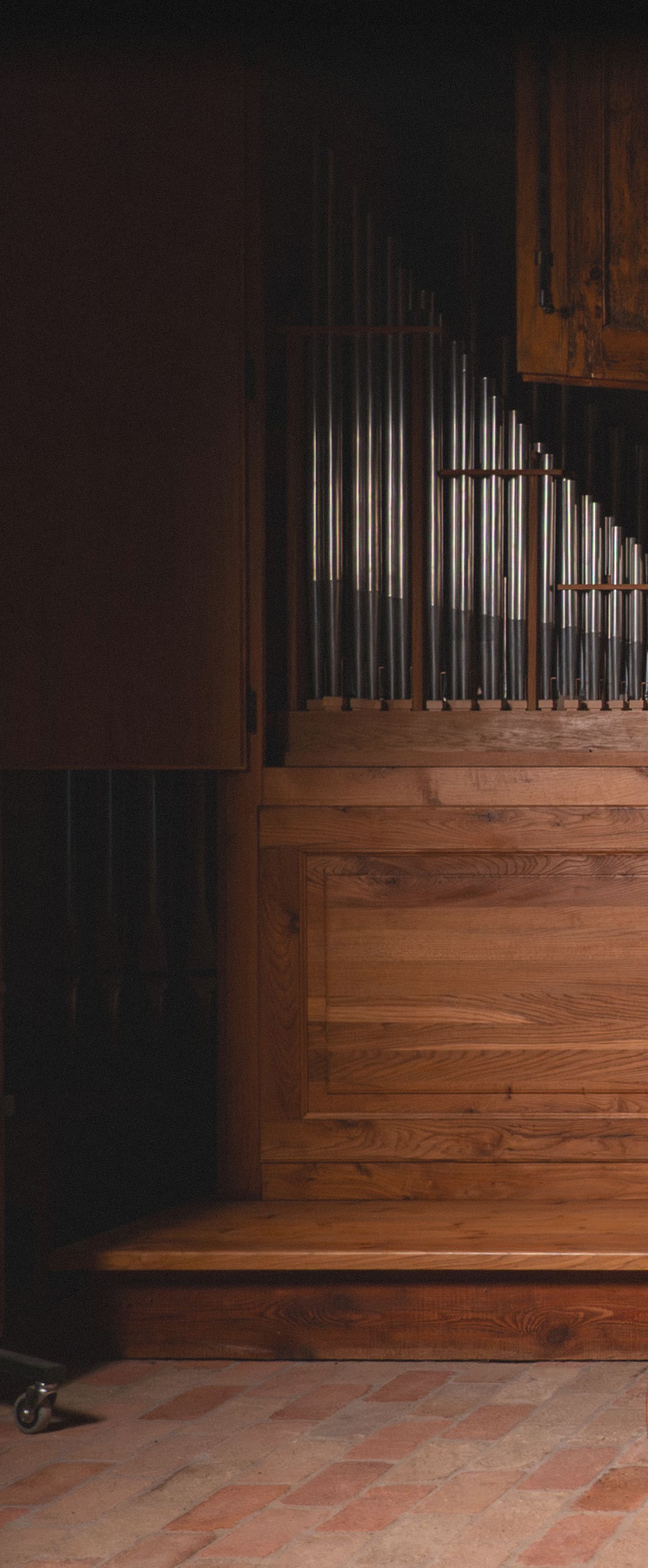
Diavolo
«Why, this is hell, nor am I out of it.»
Christopher Marlowe
Bass · strings and continuo
The seventeenth century gave the Devil a voice of his own: the bass. Deep, theatrical, capable of seducing before it frightens.
The programme follows this voice through four works in which the Devil loses, one by one, his grip on the word: Monteverdi’s Pluto, who commands; Carissimi’s Lucifer, stripped of the violins, alone with the continuo; Stradella’s damned soul, adrift in a sea of flames; and Vitali’s Devil, driven back into Tartarus to keep Mary safe.
All around them: battles, dances of the shades, chaconnes whirling like a circle that never closes.
Strega
«Women the stake could not silence.»
Contralto · strings and continuo
Before it became an accusation, witch was the name given to a woman who knew.
At first, she commands the spirits: Caldara’s Furies, Purcell’s sorceress, who calls and is answered. Then, in Händel, no one answers her invocation: «sorde da me: perché?» (deaf to me: why?).
What remains are the women who actually wrote this music: Francesca Caccini’s negative theology of love, singing all that love is not; Antonia Bembo, who must bow to a king to see her music in print; the trembling arm of Élisabeth Jacquet de la Guerre’s Judith.
And finally, the woods, where the witches’ dance breaks loose in ballads, tarantellas, songs of healing and revolt.
Sottovoce
«They spoke softly to tell each other everything.»
Soprano and bass · strings and continuo
There is a music born where words tremble and dare not become a voice, where the heart bends beneath the weight of what it loves, where speaking softly means saying everything.
From Legrenzi’s dialogue between shadow and light, word and silence, we move to the tears of Strozzi, who tells of those who dared to open their hearts and discovered the bittersweet pain that followed. Steffani finds in oblivion a longed-for place of rest, while Stradella weaves together the voices of two lovers who seek and resist each other, a mirror of desire’s ambiguity.
Thus music becomes the echo of the soul’s secrets. Where longing dwells alongside whispered names, glances and ancient memories, one may enter only on tiptoe, speaking Sottovoce.
Sete
«Flesh, mouth, skin.»
Contralto · strings and continuo
In the seventeenth century, the lover and the saint speak to each other: both believe, adore, and live in longing, upwards and towards the other.
Monteverdi’s Sì dolce recounts, with an uneasy pride, the lover’s tormented journey towards the beloved, in which he loses even himself just to come one step closer to her.
Brazen and mocking, Merula’s lover swears never to loosen the «caro laccio», just as Bononcini’s Baptist blesses and adores the pains «che dan lustro a la sua fè».
At the heart of it all is Prince Desire: tender in Cesti’s music, grotesque in Marini’s toothless old woman, vengeful in Frescobaldi, and absurdly self-satisfied in Lambert, who would die of pleasure if only he were happier.
Ferrari’s chaconne brings the programme to a close. But what if dying of love were an obstinate dance?
Miracolo
«Vivo sin vivir en mí.»
Teresa of Ávila
Soprano, contralto and bass · strings and continuo
«I live without living in myself», wrote Teresa of Ávila. Perhaps this is the Miracle: that a heart can become a dwelling place for absence; that the cold in Purcell’s music can still hold the breath of someone who has died; that, in Monteverdi, a fragile prayer rises from a vale of tears.
Some return to the frost, some call out to a lost homeland, while others, like Sances, entrust the faithfulness of a name to the passing years.
And then there are two mothers, portrayed by Merula and Liguori, bending over their cradles, with the distant shadow of the cross in their eyes. Their hands know what reason does not dare to say: every life is already a departure, and yet every life deserves to be rocked by a lullaby.
Music then becomes a gentle place of rest, and even the heavens fall silent to hear a mother’s voice singing.